
The summit’s three charity challenges
Centrepoint asked how to make the case for a new model of affordable homes for young people and build the demand and partnerships needed to scale it.
Missing People explored how to establish that someone who goes missing is safe while protecting their right not to be found.

NCVO and Media Trust asked how charities can embrace AI without small charities being left behind.
How the summit tackled the three challenges
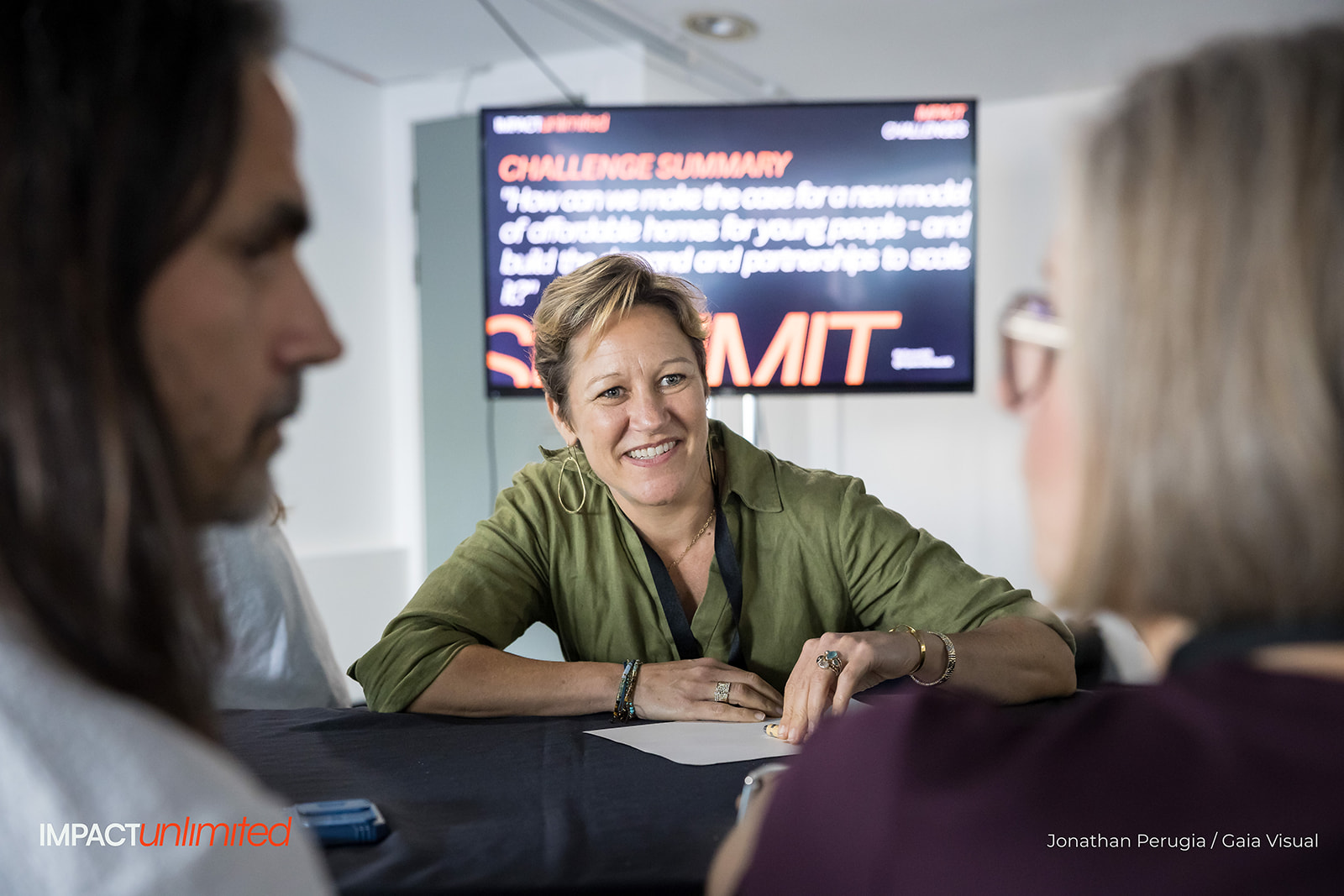
September’s Impact Unlimited Summit saw each charity challenge tackled across a pair of practical, focused workshops.
A discovery session was designed to interrogate the problem, challenge assumptions and identify two or three promising opportunity areas. Then a solutions session developed and prioritised ideas, made them practical and captured offers of help.
The aim was never to solve a complex organisational challenge in 80 minutes – that would have been impossible. We were not setting out to create a piece of new service or product design, or even run a hackathon event.
Success simply meant a better-understood problem, fresh perspectives, credible possibilities, practical next steps and people stepping forward to help.
Each charity group was supported by ‘challenge champions’, drawn from different backgrounds and areas of expertise.
Their job was to act as facilitators and catalysts. That meant asking the right questions, creating space for different voices, keeping the conversation moving and helping convert ideas into action.
Centrepoint: making the case for independent living
Centrepoint’s challenge focused on the gap between supported housing and affordable independent living. Young people who are ready to move on can remain in supported accommodation because entry-level earnings often do not stretch to private rents.
Centrepoint is testing self-contained one-bedroom homes with rent linked to earnings, with an ambition for 300 homes across new-build, modular and refurbishment schemes.
The workshops quickly established that demand from young people was not the main obstacle. The bigger task is creating demand among the organisations needed to approve, fund, build or replicate the model. Planning emerged as an immediate constraint, particularly where homes fall below the 37 sq m nationally described space standard.
The strongest idea was a clear Centrepoint ‘calling card’, adapted for three audiences. Local authorities and planners need the human story alongside evidence of social and economic value, including how difficult sites and redundant buildings can be brought back into use. Funders need a clear account of impact, economics and risk. Potential adopters need a practical blueprint that makes replication easier.
One tangible offer was help to develop a short film following a young person’s journey from homelessness into an independent Centrepoint home.
Commenting on the response to the challenge, Centrepoint’s Micheal Glenn said: “A big thank you to our challenge champions. We’ve had some great follow-up chats already and intend to progress the core ideas taken away from the workshop as we look to create a meaningful and engaging calling card for our work on the Independent Living Programme.”
Centrepoint challenge champion Benita Matofska said: “The charity came away with practical solutions, new connections and offers of support. That’s what I love about these kinds of days: moving from conversation to connection to action.”
Fellow champion Robi Dutta said it was “great to hear about Centrepoint’s new model of affordable homes for young people and be part of a group to facilitate new ideas for them. I look forward to seeing what happens next.”
Missing People: finding safety without sacrificing privacy
For Missing People, the discussion centred on a tension: how do you establish that a missing adult is safe without exposing their location, escalating too quickly to public appeals or creating a lasting digital footprint?
The workshops focused on the uncertain first days after someone goes missing.
The group’s answer was to build greater trusted and discreet reach. Ideas included developing existing ‘digital search heroes’ into a tiered, trained and potentially vetted network, expanding ‘eyes on the ground’ partnerships with hotels, supermarkets and transport providers – and exploring whether major digital platforms could provide limited signals of recent activity without revealing location.
A clear principle ran through the conversation was to establish welfare while revealing no more information than necessary.
Participants also offered practical follow-up support, including help to research international best practice and to develop a proposal for major digital platforms. The workshop ended with routes for further investigation as well as ideas on the page.
Missing People’s Ndella Senghore said: “Thank you for giving us the opportunity to introduce Missing People to a variety of people and organisations willing to help advance our work. I gained a lot of inspiration and insights outside our charity bubble that will certainly enhance our publicity offer – and most importantly bring more people to safety.”
Her colleague Teresa Forgione said the challenge offered “a chance to meet some lively, brilliant minds and lift the lid a bit on a small aspect of our work at Missing People. I look forward to hearing about what comes next.”
Missing People challenge champion Nigel Shardlow said: “It was a privilege to be a part of it, and to work on such an interesting challenge with a fantastic group of people…I would love to continue to help in any way I can.”
NCVO and Media Trust: helping small charities use AI with confidence
The NCVO and Media Trust challenge started from a growing concern that AI could widen existing inequalities across the charity sector.
Smaller organisations have less time, money and specialist capacity to experiment, while better-resourced organisations may use AI to increase the volume and sophistication of activities such as funding applications.
Three connected barriers emerged: competitive disadvantage, a lack of confidence and safe space to experiment and the absence of a clear, trusted starting point for tools and guidance. The strongest principle was simple: start with the charity’s real problem, not the technology.
The group proposed practical cohort learning, peer support and communities of practice, allowing charities to work on genuine organisational tasks and build confidence through repeated use.
It also favoured trusted signposting over a huge toolkit that could date quickly, potentially using a decision tree that starts with needs such as funding, administration or marketing and points charities towards useful tools, expertise and case studies.
Offers of support included volunteer expertise, connections, learning from the small charity-focused Pearce Foundation and possible links into funder networks.
Jade Staiano at Media Trust said: “I found the conversations thoughtful, practical and genuinely useful. I particularly enjoyed the intersection between charities, businesses and the wider impact community. Bringing together people with such different perspectives, experiences and approaches created some really interesting conversations, and felt like a valuable way to tackle complex challenges.”
AI challenge champion Jane Robbie said it was “a brilliant day and a great example of what can happen when people from across charities, business, technology and social impact come together to share their different perspectives and expertise.”
Visual scribe captures the challenges
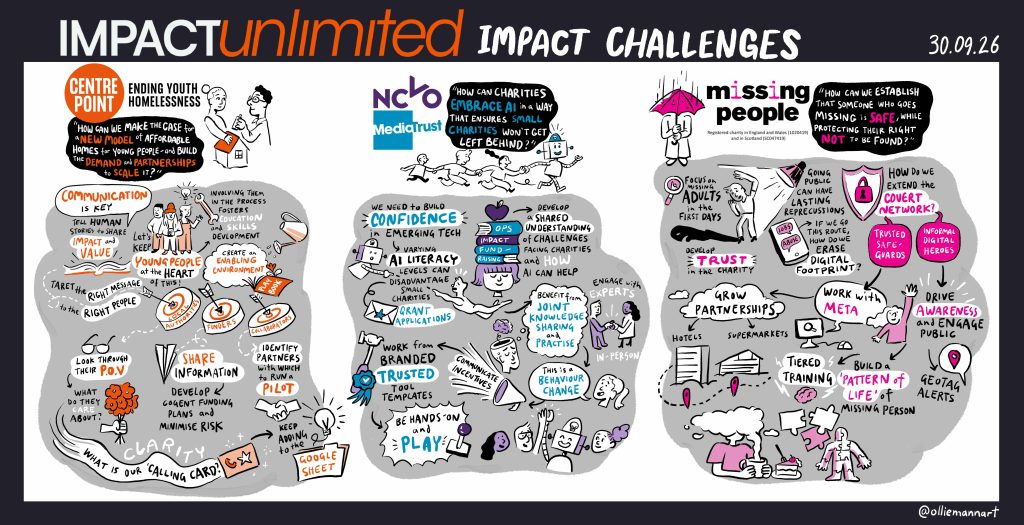
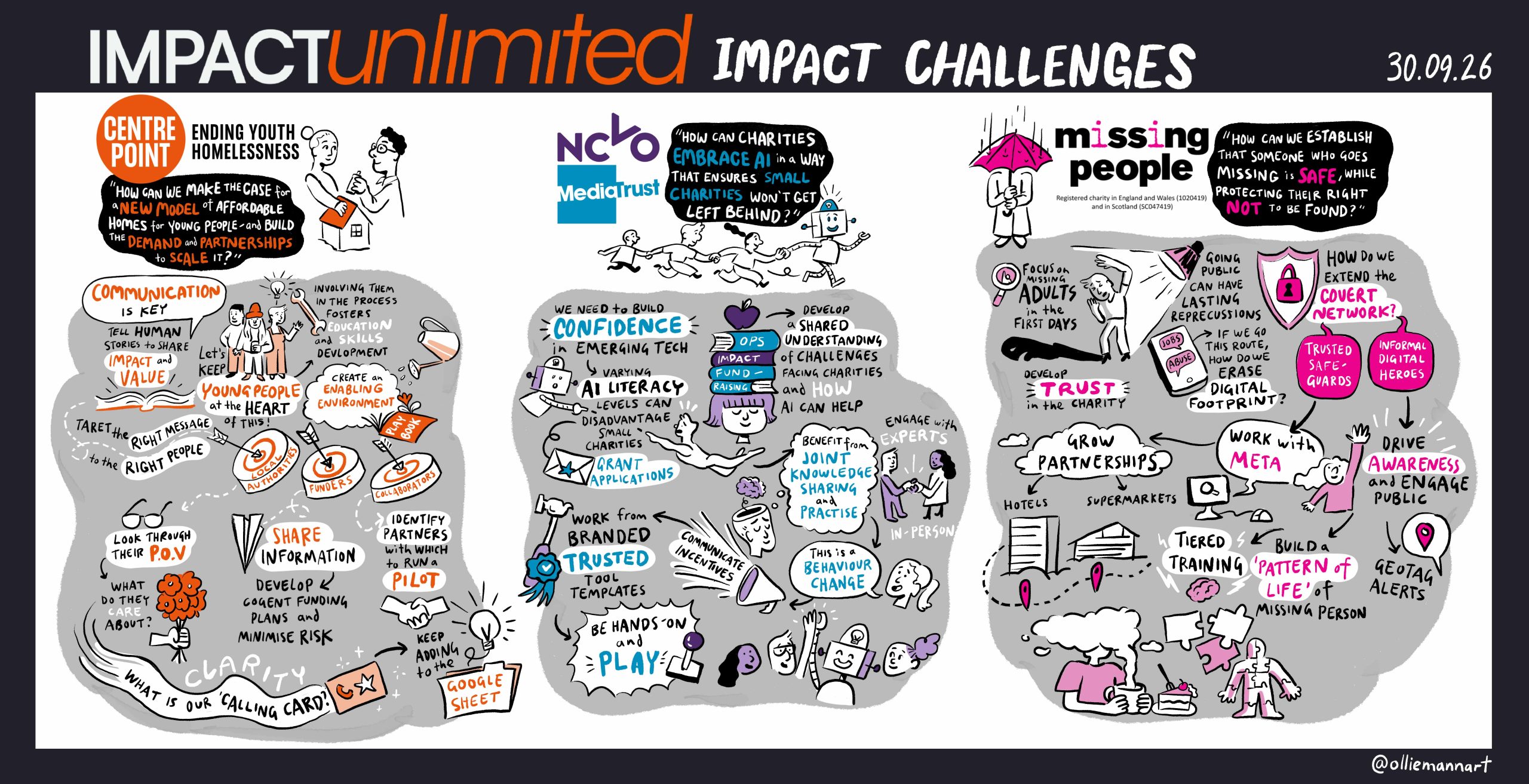
Ollie Mann, our visual scribe, captured the breadth of the thinking. Across the three challenges, the scribe images are full of practical prompts.
For Centrepoint it was about communication, partnerships and replication.
For Missing People, the focus was privacy, trained networks, digital platforms and public awareness.
For NCVO and Media Trust, it was about confidence, trusted tools and shared learning.
Trees for Cities challenge pilot
We shared the Trees for Cities film at the summit, showing what can happen when a clearly framed problem is opened up to people with different experience and perspectives.
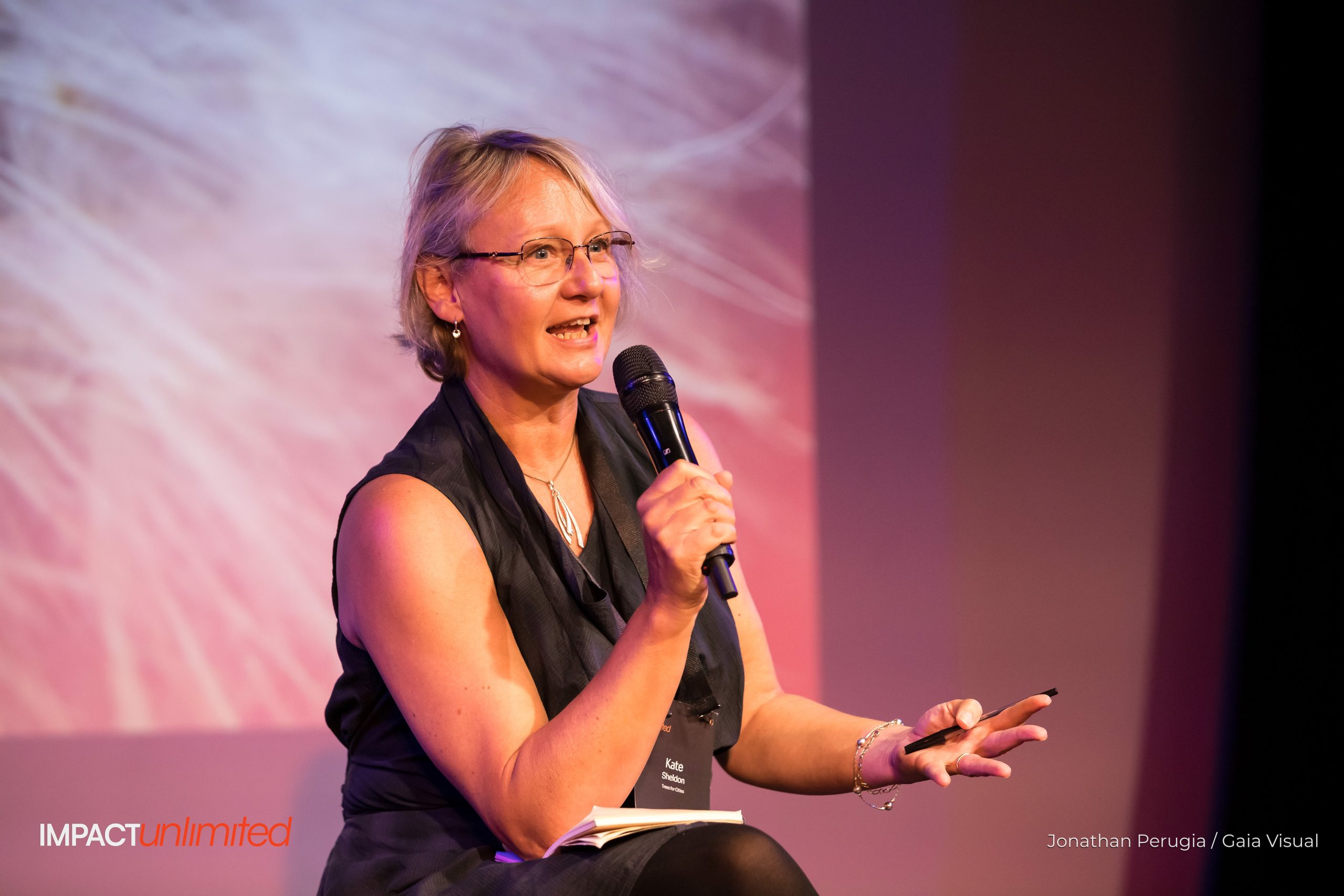
Trees for Cities, led by Chief Executive Kate Sheldon, worked with people from across business, technology and academic organisations in our network to explore practical responses, from data and technology to community engagement and partnerships. At the heart of the response were food sharing platform Olio and the citizen science team at UCL.
You can also watch the Trees for Cities film on YouTube.
So what’s next?
The real test of success comes next. The strongest ideas will be tested, introductions made and offers of help followed through.
Impact Unlimited will stay connected with the four organisations and their champions as the charities decide what to take forward.
That is the point of the Impact Challenge model. Bring a live challenge into a diverse room, understand it properly before jumping to solutions. Combine expertise that would not normally sit around the same table – then leave with something useful to act on.
We will develop the Impact Challenge further, with more opportunities for organisations to bring forward problems where collective thinking, connections and practical support can help unlock real progress. And we’ll report on progress online.
Thanks to all our charity representatives, charity champions and workshop participants. Watch this space for more!
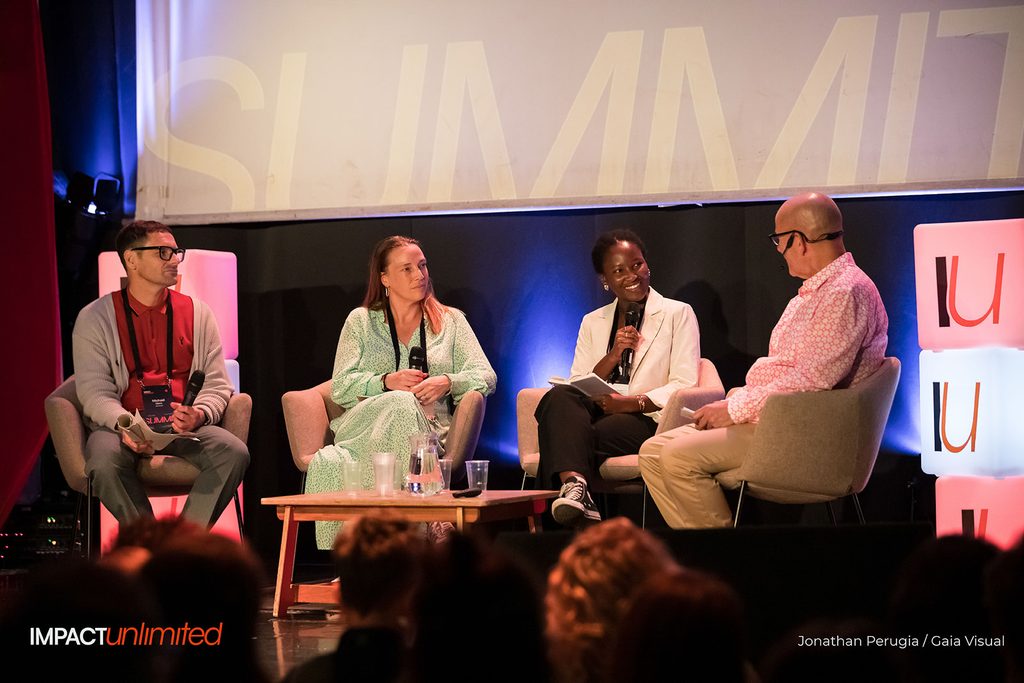
Charity representatives and challenge champions
Centrepoint
Charity representatives
- Michael Glenn, Independent Living Consultant
- John Raynham, Independent Living Development Lead
Challenge champions
- Benita Matofska, speaker and futuremaker
- Olivia Sibony, Impact Amplified
- Robi Dutta, independent TV producer and storyteller
Missing People
Charity representatives
- Teresa Forgione, Director of Fundraising and Communications (Interim)
- Ndella Sengore, Publicity and Communications Officer
Challenge champions
- Nigel Shardlow, marketing, science and data strategy consultant
- Emma Atkins, independent charity consultant
- Adam Shorts, Global TV Experts
NCVO/Media Trust
Charity representatives
- Pru Daniels, Director of Marketing, Strategy and Communications, NCVO
- Jade Staiano, Head of Communications and Impact, Media Trust
Challenge champions
- Fiona Macdonald, Independent AI adoption consultant
- Stephanie Stasey, Miss AI
- Jane Robbie, The Pearce Foundation
If your organisation has a challenge that could benefit from future fresh thinking and expert input, we’d love to hear from you. Fill in our short form to explain your challenge.
lllustration by Ollie Mann. Photo by Jonathan Perugia.
Want to find out more? Sign up for our newsletter below.